What does OSHA Table D-1 require for construction toilets?
OSHA 29 CFR 1926.51(c), Table D-1, sets the minimum toilets on a construction site. Crews of 20 or fewer need 1 toilet. Crews of 20 or more need 1 toilet seat and 1 urinal per 40 workers. Crews of 200 or more need 1 toilet seat and 1 urinal per 50 workers.
| Number of employees | Minimum facilities (Table D-1) |
|---|---|
| 20 or fewer | 1 |
| 20 or more | 1 toilet seat and 1 urinal per 40 workers |
| 200 or more | 1 toilet seat and 1 urinal per 50 workers |
Where there is no sewer, OSHA allows chemical and similar portable toilets unless local codes say otherwise. Read the full rule at OSHA 1926.51.
How many porta potties do 10, 25, 45, 80 or 210 workers need?
Using Table D-1, 10 workers need 1 toilet. 25 workers need 1 seat and 1 urinal. 45 workers need 2 of each, and so do 80 workers. 210 workers fall in the 200-plus row, so 210 divided by 50 rounds up to 5 seats and 5 urinals.
| Workers | Table D-1 row | Math | Minimum seats + urinals | Standard units (1 seat + 1 urinal each) |
|---|---|---|---|---|
| 10 | 20 or fewer | flat minimum | 1 toilet | 1 |
| 25 | 20 or more | 25 ÷ 40 = 0.6, round up | 1 + 1 | 1 |
| 45 | 20 or more | 45 ÷ 40 = 1.1, round up | 2 + 2 | 2 |
| 80 | 20 or more | 80 ÷ 40 = 2 | 2 + 2 | 2 |
| 210 | 200 or more | 210 ÷ 50 = 4.2, round up | 5 + 5 | 5 |
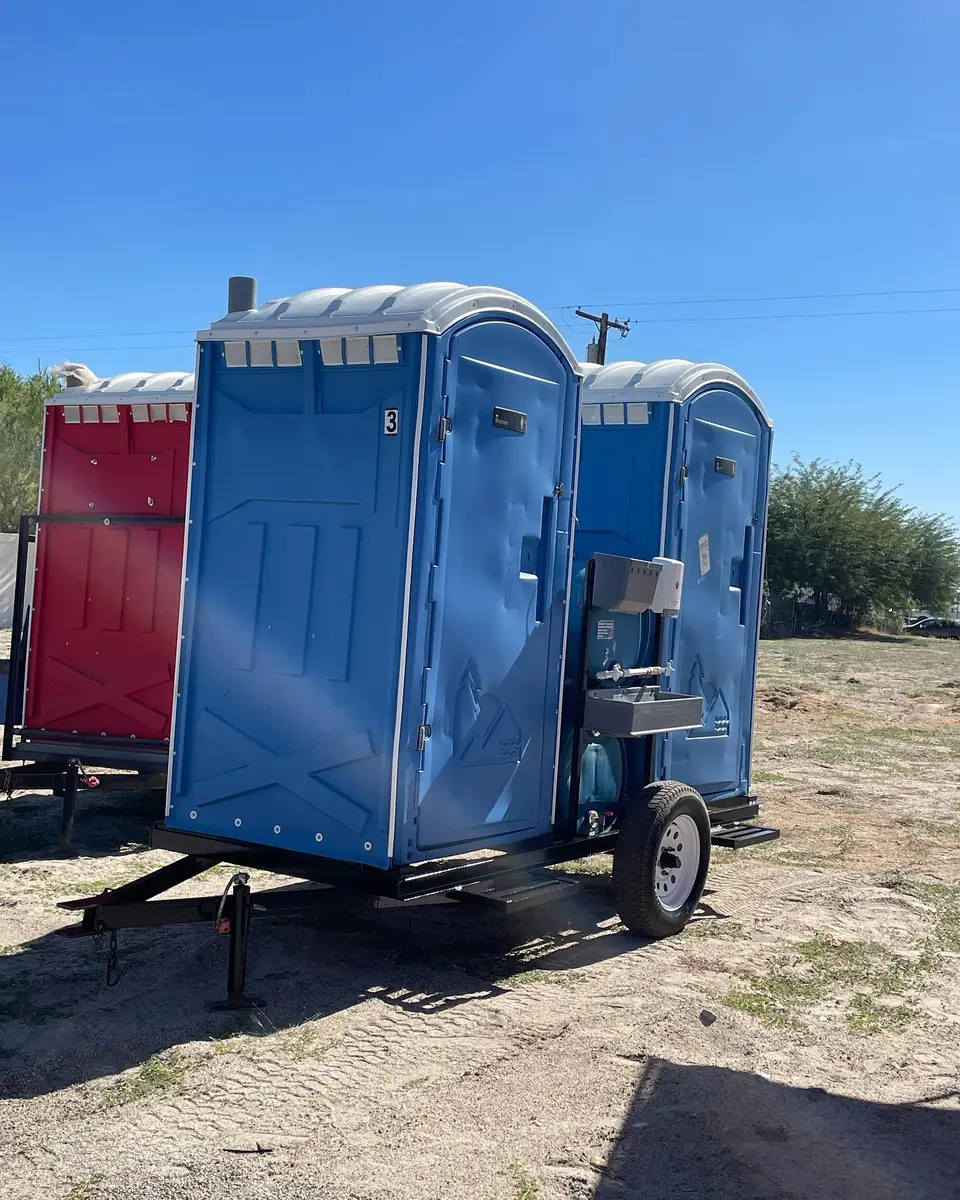
Each PolyJohn PJN3 standard unit has 1 seat and 1 urinal inside. Many contractors count one unit as both. Confirm how your safety program counts them, and treat these numbers as the floor, not the goal.
At 80 workers on 2 units, lines form at lunch. Many superintendents add a third unit and more service. This is not legal advice.
Questions about osha jobsite toilet rules? Ask Mark's office.Quote requests get a call back within 1 business hour, Mon–Sat 7 AM–7 PM.
Call (972) 812-6200Get quoteDoes OSHA require handwashing stations on construction sites?
OSHA 1926.51(f) requires adequate washing facilities when workers apply paints, coatings, herbicides or insecticides, or work around other harmful contaminants. The washing facilities must be near the worksite and kept sanitary. Many contractors add a hand wash station anyway, because a 22-gallon sink costs less than sick days.
Painting, drywall finishing, roofing coatings and landscaping chemicals are common triggers. A portable hand washing station next to the toilets covers most crews.
Standard units also include a hand sanitizer dispenser, refilled at every service.
How often should jobsite toilets be serviced?
We recommend weekly service as the baseline for jobsite toilets, and our 28-day rentals include it. Each visit pumps the 60-gallon tank, cleans surfaces and restocks paper and sanitizer. When a crew grows or a pour week doubles the headcount, add a second visit that week, quoted first.
OSHA expects facilities to be kept in sanitary condition. A unit that runs full by Thursday is not sanitary, no matter the headcount on paper.
- Tell us the crew size when you book, not just the number of units.
- Flag big weeks: concrete pours, inspections, trade overlap.
- Keep a clear path for the service truck within about 15 feet.
Do mobile crews need a porta potty at every stop?
No. OSHA 1926.51(c)(4) says the toilet requirements do not apply to mobile crews that have transportation readily available to nearby toilet facilities. Think utility locators, short service calls and road crews that move all day. A crew parked at one site for days is not a mobile crew.
The key words are readily available and nearby. If the closest public restroom is a long drive away, or the truck leaves with the foreman, the exception is shaky. A towable or trailer-mounted unit can follow a crew that moves every few days.
What toilet rules apply to farm crews in Texas?
Farm crews follow OSHA 29 CFR 1928.110, not Table D-1. When 11 or more employees do hand labor in the field on a given day, the farm needs 1 toilet and 1 handwashing facility per 20 workers, within a quarter-mile walk. Crews in the field 3 hours or less that day are exempt.
The rule also calls for cool drinking water. When the field is too rough for a truck, units can go at the nearest point vehicles can reach. See our season-long rental guide for harvest seasons and OSHA 1928.110 for the text.
What about plants, warehouses and other general industry sites?
Plants, warehouses and other fixed workplaces fall under OSHA 29 CFR 1910.141, the general industry sanitation rule, not the construction table. During a shutdown, expansion or restroom remodel, portable units can fill the gap. In our 2026 call study, 15% of live calls, 25 of 172, came from construction jobsites.
Industrial clients often want trailer-mounted units they can move with a forklift or truck. See industrial portable restrooms for plant and shutdown setups, and OSHA 1910.141 for the rule.